

Introduction
When working in hazardous environments where toxic gases, smoke, or oxygen deficiency pose serious health risks, reliable respiratory protection is essential. Breathing apparatus systems are designed to provide clean, breathable air in such situations, protecting workers across industries such as firefighting, chemical processing, and confined space entry.
There are three main types of breathing apparatus, each suited to different applications and working conditions: Self-Contained Breathing Apparatus (SCBA), Airline Breathing Apparatus (Airline BA), and Escape Breathing Apparatus (EBA). In this blog post, we’ll explore the key differences between these systems, how they work, and when each type should be used to ensure maximum safety and compliance.
Escape Breathing Apparatus (EBA)
An Escape Breathing Apparatus (EBA) is a respiratory protective device intended for emergency use, offering a short-term supply of breathable air. It allows users to safely exit environments that have suddenly become hazardous. Designed to be lightweight and easy to carry, the EBA typically includes a small compressed air cylinder connected to either a face mask or a hood. Its primary function is to protect individuals in situations such as gas leaks or unexpected drops in oxygen levels.
The main purpose of an EBA is to provide a temporary and safe supply of air to those who find themselves in environments that are immediately dangerous to life or health. This could result from the sudden presence of toxic gases, a reduction in oxygen concentration, or the release of smoke and other contaminants. Unlike systems designed for long-term work, the EBA is used solely for evacuation and is not intended for extended stays in dangerous settings.
Key components of the EBA include a small, high-pressure air cylinder and a face mask or hood. The air cylinder contains breathable air and is designed for short durations. The face mask offers a sealed fit to prevent contaminated air from being inhaled, while the hood covers the entire head and is easier to put on quickly. Hoods are particularly useful for untrained users or individuals with facial hair or glasses that may interfere with a mask’s seal.
The duration of use for an EBA typically ranges from 10 to 30 minutes, depending on the breathing rate of the user and the design of the device. This limited timeframe means that users must act quickly to exit the hazardous area.
EBAs are commonly used in confined spaces such as tanks or silos, where there is a risk of toxic gas release or oxygen deficiency. They are also utilised in chemical plants and industrial sites where chemical spills or gas releases can occur. Tunnels, underground facilities, marine vessels, and offshore platforms are other environments where EBAs serve as a vital safety measure, providing workers with enough time to evacuate.
Among the advantages of EBAs is their quick deployment. They are simple to use and easy to carry due to their compact design. However, their limitations include a short air supply and the fact that many are designed for one-time use. Once activated, the unit typically needs to be refilled or serviced before it can be used again.
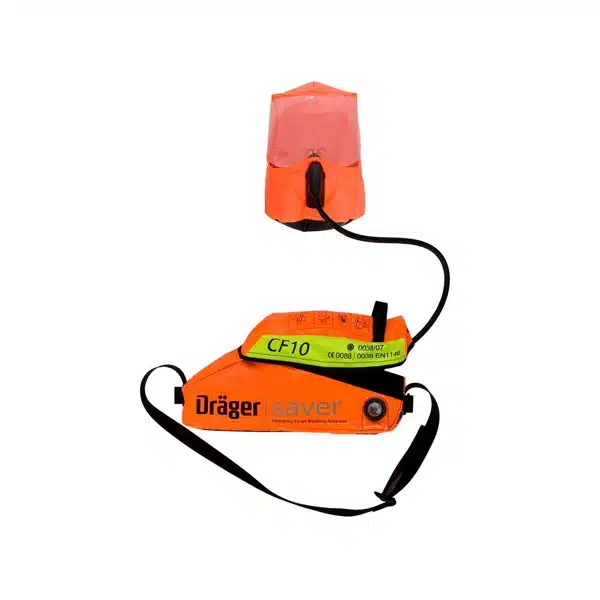
Drager Saver CF
The Dräger Saver CF constant flow Emergency Escape Breathing Apparatus allows safe, effective and uncomplicated escape from hazardous environments. Simple to put on and featuring automatic operation, this hood-based, constant flow breathing device can be used with minimal training.
The Dräger Saver CF utilises a simple, fail-safe reducer system with excellent flow characteristics, providing a consistent rate of air flow until the cylinder is completely empty. An alarm whistle sounds before the air supply is exhausted. It can be equipped with cylinders which can hold either a 10 or 15 minute supply of air. The flame-retardant hood incorporates a large visor for maximum peripheral vision.
Self-Contained Breathing Apparatus (SCBA)
A Self-Contained Breathing Apparatus (SCBA) is a respiratory protection device that provides clean, compressed air from a cylinder worn by the user. This allows individuals to breathe safely in environments where the ambient air is either unsafe or insufficient. An SCBA includes a high-pressure air cylinder, a regulator, a face mask, and a harness, and is widely used by firefighters, rescue personnel, and industrial workers operating in hazardous conditions.
The purpose of the SCBA is to support users working in areas that are known to pose a serious threat to life or health. In contrast to the EBA, which is used for quick escape, the SCBA is designed for sustained activity within dangerous environments.
The components of an SCBA system begin with the high-pressure air cylinder, which contains compressed breathable air in greater volume than an EBA, allowing for extended use. The regulator ensures that this air is delivered at a safe and consistent pressure to the user. The face mask seals the user’s face completely, preventing exposure to harmful substances while offering clear visibility and often the ability to communicate. A harness and backplate distribute the weight of the equipment evenly, making it easier to wear during physically demanding tasks. Many SCBAs also feature an audible alarm that alerts the user when the air supply is running low.
Depending on the cylinder size and the user’s breathing rate, an SCBA can typically provide air for 15 minutes, 30 minutes, 45 minutes to 60 minutes. It is essential that users monitor their remaining air supply and know their operational limits while using the apparatus.
SCBAs are critical tools for firefighters, allowing them to enter smoke-filled or toxic environments to carry out rescue and extinguishing operations. They are also used during the handling of hazardous materials, where contact with chemical vapours or toxic substances is a risk. SCBAs are standard for disaster response teams, especially in the case of chemical spills or gas leaks, and are essential for rescue operations in mines, tunnels, and other underground locations.
The benefits of SCBAs include their mobility, since the unit is worn on the back and requires no connection to an external air source. They also offer longer operational times compared to EBAs and provide complete facial and respiratory protection. However, there are drawbacks. The weight and size of the unit can be restrictive, particularly in tight spaces. While they offer more air than EBAs, the supply is still limited and must be managed carefully. SCBAs also require regular maintenance and thorough inspection to ensure reliability.
Dräger PSS 7000
The Dräger PSS 7000 is a high-performance self-contained breathing apparatus (SCBA) specifically designed for firefighting and use in toxic environments. It offers reliable respiratory protection while prioritising user comfort and durability in extreme conditions.
Its ergonomic design includes a rigid harness connection to an easily adjustable backplate, along with padded shoulder and waist support. A pivoting waist belt allows the SCBA to move with the wearer, maintaining a secure and stable fit during demanding operations.
Users can select between a standard pneumatic gauge or upgrade to the Bodyguard 7000, a multifunctional device combining a pressure gauge, data logger and distress signal unit. The SCBA is also height adjustable and constructed with tough materials such as stainless steel buckles and Aramid blend webbing.
The unit weighs 11.7kg (12.2kg with the Bodyguard 7000) and conforms to EN 137:2006 Type 2 and vfdb 0802 standards. It requires the additional selection of a compatible facemask, lung demand valve (LDV), and cylinder.

Airline Breathing Apparatus (Airline BA)
An Airline Breathing Apparatus, or Airline BA, is a respiratory protection system that delivers a continuous supply of clean air through a long hose connected to a remote air source. Unlike self-contained units, it relies on external air cylinders or compressors, which makes it suitable for prolonged use in hazardous environments.
The system consists of several key components. The air source may be a compressor or a set of high-pressure cylinders, positioned safely away from the hazardous zone. The user is connected to this source via a long, durable airline hose, which can extend over 100 metres in some cases. The face mask creates a sealed space around the user’s face, ensuring only clean air is inhaled. Many systems also include an airline harness to manage the hose and reduce the risk of tangling. Importantly, many Airline BAs also feature an emergency escape cylinder that activates if the main air supply is interrupted, offering 10 to 15 minutes of air to exit safely.
The main benefit of an Airline BA is the virtually unlimited air supply, as long as the external source remains operational. This makes the system highly effective for tasks that require a long duration of work in contaminated or low-oxygen environments. However, the escape cylinder only provides a short backup in case of air source failure.
Airline BAs are commonly used for tasks like tank cleaning, where workers may be inside enclosed spaces for extended periods. They are also used in sandblasting, painting, and other industrial jobs where continuous exposure to dust or fumes can be hazardous. In some shallow underwater operations, especially where full mobility is not required, an Airline BA may also be used. Confined space work in industrial facilities is another setting where this equipment provides vital respiratory protection.
The advantages of the Airline BA system include a constant air supply, reduced fatigue due to the absence of a heavy air cylinder, and cost efficiency for longer-duration tasks. However, it does come with some limitations. The user’s movement is restricted by the hose, which can become a tripping hazard or snag on equipment. There is also a dependency on the integrity of the external air source. If this fails, the user’s safety could be at risk. Additionally, the hose itself may be susceptible to damage in harsh environments.
To ensure safe use, workers must be properly trained in how to inspect and manage their equipment. Regular checks of the hose condition and emergency escape cylinder are essential. The work area should be organised to prevent hose entanglement or exposure to damaging conditions. Clear communication between the user and a safety observer should also be maintained throughout the operation.
